Quick Definition: IPTV (Internet Protocol Television) is a technology that delivers live TV channels, on-demand movies, and TV shows over your internet connection — instead of through a cable wire or satellite dish. In Canada, it’s one of the fastest-growing alternatives to Bell Fibe, Rogers Ignite, and Shaw BlueSky.
You open your Bell or Rogers bill and stare at the number: $147. Maybe $162. Maybe more, if you added a sports package to watch the Leafs or the Canadiens. And you’re thinking — there has to be a better way.
There is. It’s called IPTV, and chances are you’ve already heard someone mention it. Maybe on Reddit, maybe at work, maybe a friend who told you they cut the cord and haven’t looked back. But what is IPTV exactly? Is it legal? Will you actually get CBC, TSN, and RDS? And is it as reliable as your cable subscription?
This guide answers every single one of those questions — with no hype, no jargon, and no American-centric information that doesn’t apply north of the border. Let’s get into it.
What Is IPTV? (Plain-English Definition)
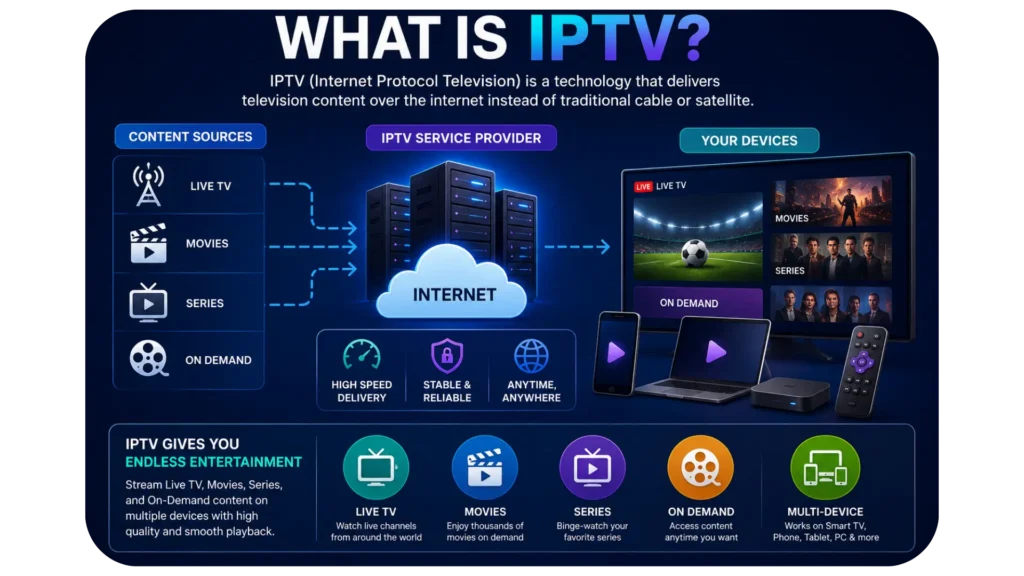
IPTV stands for Internet Protocol Television. Instead of receiving TV signals through a coaxial cable (like Bell or Rogers) or via a satellite dish, IPTV sends television content over the same internet connection you already use for Netflix, YouTube, and everything else.
Think of it this way: when you stream a show on Netflix, you’re receiving video data over your internet connection. IPTV works on the same basic principle — but instead of an on-demand library, it delivers live channels, scheduled programming, and a massive video-on-demand library, all through one subscription.
The big difference? IPTV can give you access to thousands of live channels — local Canadian networks, US channels, international content, sports, and pay-per-view — for a fraction of what cable costs.
What Does IPTV Stand For?
IPTV = Internet Protocol Television. The “Internet Protocol” part refers to the technical method used to send the data — the same IP standard that powers the entire internet. The “television” part is self-explanatory: it’s TV, just delivered differently.
Some people also use the term loosely to refer to streaming services in general, but technically, IPTV specifically means live TV delivered over an IP network — as opposed to OTT (Over-the-Top) services like Netflix or Crave, which are purely on-demand.
How Is IPTV Different From Regular TV?
| Feature | Traditional Cable/Satellite | IPTV |
|---|---|---|
| Delivery method | Coaxial cable or satellite dish | Internet connection |
| Hardware required | Set-top box from provider | Any smart device or IPTV box |
| Contract required | Usually 2-year term | Month-to-month (most services) |
| Channel count | 100–500 channels | 5,000–60,000+ channels |
| 4K content | Limited | Widely available |
| Canadian channels | Yes (local networks) | Yes (on good services) |
| Monthly cost (Canada) | $80–$180+ | $15–$40 |
| DVR/Catch-up TV | Extra cost | Often included |
| Portability | Home only | Works anywhere with internet |
The core difference is freedom. Cable locks you into a geographic location, a contract, and a box. IPTV goes wherever your internet connection goes.
How Does IPTV Work? (Step-by-Step)
Here’s the journey your TV signal takes when you use IPTV:
- Content is acquired — The IPTV provider licenses or sources live TV feeds, movies, and shows from broadcasters and content owners around the world.
- Content is encoded — The raw video signal is compressed into a digital format (usually H.264 or H.265) so it can travel efficiently over the internet.
- Content is stored on servers — The provider hosts this content on powerful servers, usually distributed across multiple data centres for reliability.
- You request a channel — You open your IPTV app, pick a channel, and send a request to the server.
- The stream is delivered — The server sends the video data to your device over your internet connection in real time.
- You watch TV — Your IPTV app decodes the stream and plays it on your screen, just like regular TV — except it came through your router, not a cable in your wall.
The whole process happens in milliseconds. On a good IPTV service with a solid internet connection, the experience is indistinguishable from cable TV.
The Three Types of IPTV Content
IPTV services typically offer three content categories:
1. Live TV — Real-time channels, just like cable. Sports, news, entertainment, all broadcasting as they happen. This is the core of any IPTV service.
2. Video on Demand (VOD) — A library of movies and TV shows you can watch any time, similar to Netflix. Quality IPTV services offer 50,000–180,000+ VOD titles.
3. Time-Shifted TV / Catch-Up — Missed the hockey game? Many IPTV services let you rewind and watch content from the past 7 days. This is what cable companies call “on-demand replay.”
Live TV vs. VOD vs. Time-Shifted TV
Most Canadians use IPTV primarily for live TV — the sports, news, and live events that streaming services like Netflix don’t offer. The VOD and catch-up features are a bonus that comes with most subscriptions.
IPTV vs. Cable TV in Canada — Side-by-Side Comparison
This is the comparison most Canadians actually want to see. Here’s how IPTV stacks up against the big Canadian cable providers.
| Category | Bell Fibe TV | Rogers Ignite | Shaw BlueSky | IPTV (Average) |
|---|---|---|---|---|
| Starting monthly price | ~$85 CAD | ~$80 CAD | ~$75 CAD | ~$15–$25 CAD |
| Contract required | 2-year preferred | 2-year preferred | Month-to-month | None |
| Number of channels | 200–500 | 150–400 | 150–350 | 10,000–60,000 |
| 4K channels | Limited | Limited | Limited | Widely available |
| VOD library | Included (limited) | Included (limited) | Included (limited) | 50,000–180,000+ titles |
| Sports channels (TSN, Sportsnet) | Extra cost | Extra cost | Extra cost | Usually included |
| Catch-up TV | Yes | Yes | Yes | Yes (most services) |
| Works on mobile | App (extra fee) | App (extra fee) | App (extra fee) | Yes, included |
| Cancel anytime | No (penalty) | No (penalty) | Yes | Yes |
| Annual cost estimate | $1,020–$2,160+ | $960–$2,000+ | $900–$1,800+ | $180–$360 |
The annual savings alone — potentially over $1,500 per year — is why hundreds of thousands of Canadians are ditching cable every year. Statistics Canada has reported consistent year-over-year declines in cable subscriptions as cord-cutting accelerates.
Is IPTV Legal in Canada? (The Honest Answer)
This is the question every Canadian asks, and it deserves a straight answer — not corporate hedging.
The short answer: IPTV the technology is 100% legal in Canada. Many major Canadian broadcasters operate their own IPTV services (Bell Fibe TV, Rogers Ignite, and Telus Optik are all IPTV services in the technical sense). What matters is whether the content being delivered is licensed.
What the CRTC Says
The Canadian Radio-television and Telecommunications Commission (CRTC) regulates broadcasting in Canada. The CRTC does not prohibit IPTV technology itself. What it does regulate is the distribution of broadcast content.
Licensed Canadian IPTV providers — like Bell, Rogers, and Telus — operate under CRTC broadcasting licences. They pay content rights fees to broadcasters and comply with Canadian content (CanCon) regulations.
A third-party IPTV subscription service that carries licensed content legally (like YouTube TV, which operates under US licensing) is legal in that jurisdiction. The legality becomes complicated when services distribute content without proper licensing agreements — which is the “grey market” territory.
Licensed vs. Unlicensed IPTV Services
There are two broad categories of IPTV services you’ll encounter in Canada:
Licensed/Legal Services: These hold proper broadcasting licences and content rights. Examples include:
- Bell Fibe TV, Rogers Ignite, Telus Optik, Shaw BlueSky (Canadian IPTV)
- YouTube TV, Sling TV, Hulu + Live TV (US-licensed, accessible with VPN)
- CBC Gem, TSN Direct, RDS Direct, Sportsnet Now (legal Canadian streaming)
Unlicensed/Grey Market Services: These are third-party subscriptions — often sold online for $10–$30/month — that carry thousands of channels without paying licensing fees to the original broadcasters. These services operate in a legal grey area, and in some cases, using them may expose you to legal risk under Canada’s Copyright Act.
The Grey Market: What You Need to Know
Many Canadians use grey market IPTV services and never encounter legal issues. The reality is that enforcement in Canada has historically targeted providers rather than individual subscribers. However:
- The Copyright Act in Canada does make it illegal to receive copyrighted content without authorization
- Bill C-11 (the Online Streaming Act, 2023) has expanded the CRTC’s powers over digital content
- Some ISPs (Bell, Rogers, Telus) have been granted court orders to block certain IPTV-related domains
- The legal risk, while currently low for individual users, is not zero
Our recommendation: Stick with licensed services where possible, or use services with transparent, clean licensing. If you’re unsure, this is a conversation for a legal professional — not a streaming blog.
What Canadian Channels Can You Watch on IPTV?
Channel availability varies by service, but most quality IPTV subscriptions include strong Canadian coverage.
English Canadian Channels
On a well-selected IPTV service, you can typically access:
- CBC (CBC News, CBC Kids, CBC Arts)
- CTV (CTV 2, CTV News, CTV Life)
- Global TV
- Citytv
- CP24 (24-hour news, essential for Toronto viewers)
- CityNews channels (Vancouver, Calgary, Edmonton)
- TSN 1–5 (The Sports Network — hockey, football, basketball)
- Sportsnet (national and regional: Pacific, West, Ontario, East)
- W Network, HGTV Canada, Food Network Canada
- Crave channels (where licensed)
French Canadian Channels (Pour le Québec)
One area where most “What is IPTV” guides completely fail is French Canada. Québécois viewers have specific needs — and good IPTV services deliver:
- Radio-Canada (French CBC)
- TVA (one of Québec’s most-watched channels)
- Noovo (formerly V, part of Bell Media)
- RDS 1 & 2 (Réseau des sports — the TSN equivalent for French Canada)
- TVA Sports
- Télé-Québec
- Canal D, Historia, Zeste
If you’re in Québec and want local French-language content, look for IPTV services that specifically list Canadian French channels in their lineup.
Regional and Sports Channels
Sports is often the deciding factor for Canadians considering the switch. Most premium IPTV subscriptions include:
- All 5 TSN feeds
- All 5 Sportsnet feeds (including Sportsnet 360)
- Regional sports networks
- ESPN, FS1, NBC Sports, beIN Sports
- NFL RedZone, MLB.tv-style access
- NHL, CFL, NBA League Pass-equivalent coverage
How Much Does IPTV Cost in Canada?
| Service Type | Monthly Cost (CAD est.) | Annual Cost (CAD est.) | What You Get |
|---|---|---|---|
| Bell Fibe TV (Starter) | $85–$120 | $1,020–$1,440 | 200–400 channels, limited 4K |
| Rogers Ignite (Basic) | $80–$110 | $960–$1,320 | 150–350 channels |
| Shaw BlueSky (Start) | $75–$100 | $900–$1,200 | 150 channels, limited 4K |
| Premium IPTV service | $15–$25 | $60–$120 (annual plans) | 10,000–60,000 channels, 4K, VOD |
| Mid-tier IPTV service | $25–$40 | $120–$200 | 20,000+ channels, 4K |
| YouTube TV (with VPN) | ~$95 USD | ~$1,140 USD | US channels, limited CA content |
The math is hard to argue with. Even a premium IPTV service at $25 CAD/month costs $300/year — versus $1,000–$2,000+ for Bell or Rogers. That’s $700–$1,700 back in your pocket annually.
Pro tip: Many IPTV services offer annual plans at a significant discount — sometimes as low as $60–$80 CAD for the full year. Always compare monthly vs. annual pricing before subscribing.
What Devices Work With IPTV in Canada?
One of IPTV’s biggest advantages over cable is device flexibility. You’re not stuck with one set-top box in one room. Here’s what works:
Smart TVs (Samsung, LG)
Most modern Samsung (Tizen OS) and LG (webOS) Smart TVs can run IPTV apps directly. Apps like Smart IPTV, IPTV Smarters, and GSE Smart IPTV are available for these platforms. Setup typically takes 5–10 minutes.
Amazon Firestick and Fire TV
The Amazon Firestick is the most popular IPTV device in Canada. You can download IPTV apps directly from the Amazon Appstore, or sideload apps like IPTV Smarters Pro and TiviMate for more advanced features. The Firestick 4K Max is especially popular for 4K IPTV streaming.
iPhone, iPad, and Apple TV
iOS users can access IPTV through apps like GSE Smart IPTV, IPTV Smarters, and OTTPlayer, all available on the App Store. Apple TV supports the same apps and connects directly to your TV for a clean experience.
Android Phones and Android TV
Android gives you the most flexibility. Apps like TiviMate, IPTV Smarters Pro, and Perfect Player are free or low-cost and offer powerful features including EPG guides, catch-up TV, and multi-screen viewing.
Android TV boxes (like the NVIDIA Shield or Xiaomi Mi Box) are popular in Canada as dedicated IPTV devices — they give you full Android functionality connected to your TV.
What Internet Speed Do You Need for IPTV in Canada?
IPTV requires a stable internet connection, but it doesn’t need to be blazing fast. Here’s a simple breakdown:
| Stream Quality | Minimum Speed Needed |
|---|---|
| Standard Definition (SD) | 5 Mbps |
| High Definition (HD) | 10–15 Mbps |
| Full HD (1080p) | 15–25 Mbps |
| 4K Ultra HD | 25–50 Mbps |
| Multiple streams simultaneously | Add 15–25 Mbps per additional stream |
Most Canadian home internet plans — even basic packages from Bell, Rogers, or Telus — easily exceed these requirements. The issue isn’t usually raw speed; it’s stability and throttling.
Canadian ISP Throttling — What to Know
Here’s something your cable company won’t advertise: Bell, Rogers, and Telus have all been known to throttle (slow down) streaming traffic — especially during peak hours (evenings, weekends). If your IPTV keeps buffering even on a fast connection, ISP throttling is often the culprit.
You can test for throttling using tools like Speedtest.net and FAST.com — compare your results at different times of day. A significant drop in speed during evenings is a red flag.
Do You Need a VPN for IPTV in Canada?
A VPN (Virtual Private Network) is not strictly required for IPTV, but it solves two Canadian-specific problems:
- ISP throttling: A VPN encrypts your traffic, making it harder for Bell or Rogers to identify and throttle your streaming. Many Canadian IPTV users report significantly better streaming performance with a VPN.
- Privacy: A VPN adds a layer of privacy around your streaming activity, which some users prefer — especially when using grey market services.
Popular VPNs among Canadian IPTV users include ExpressVPN, NordVPN, and Surfshark. Look for servers in Canadian or US cities for the best performance.
IPTV vs. Netflix, Crave, and Other Streaming Services
It’s a fair question: if you already have Netflix and Crave, why do you need IPTV?
The answer is live TV. Netflix, Crave, Disney+, Amazon Prime — these are all on-demand services. They don’t have live channels. You can’t watch a live Canadiens game, the NHL playoffs, the Super Bowl, breaking news on CP24, or a live CTV drama premiere on Netflix.
IPTV fills that gap. It’s the live-TV layer that makes cord-cutting fully work.
| Feature | IPTV | Netflix | Crave | CBC Gem |
|---|---|---|---|---|
| Live TV channels | Yes (thousands) | No | No | Some (CBC only) |
| On-demand movies | Yes (50K+) | Yes | Yes | Limited |
| Canadian channels | Yes | No | Limited | CBC only |
| Sports (live) | Yes | No | No | No |
| Monthly cost (CAD) | $15–$40 | $17–$23 | $20–$24 | Free / $4.99 |
| 4K content | Yes | Yes | Some | No |
Many Canadians use IPTV alongside Netflix — replacing cable entirely but keeping their Netflix subscription for the original content. That combined cost is still dramatically lower than a full Bell or Rogers package.
The Pros and Cons of IPTV for Canadians
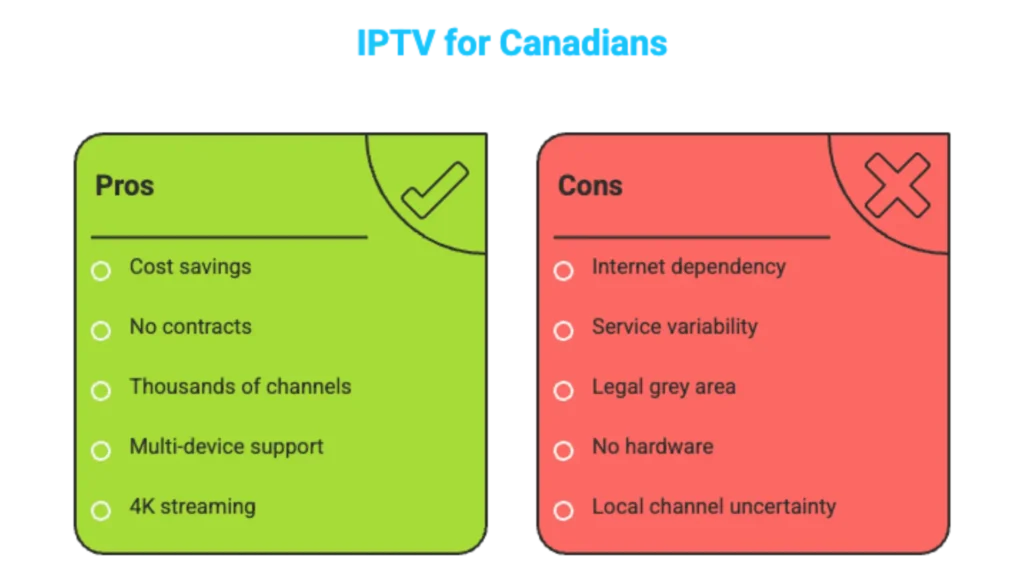
Pros
- Massive cost savings — Save $700–$1,500+ per year vs. Bell or Rogers
- No contracts — Cancel any time, no early termination fee
- Thousands of channels — Including Canadian, US, international, and sports
- Works on all your devices — TV, phone, tablet, laptop
- 4K streaming — Often without extra cost
- Massive VOD library — Tens of thousands of movies and shows
- Catch-up TV — Watch what you missed, often up to 7 days back
- French Canadian content — RDS, TVA, Radio-Canada available on good services
- Multi-room viewing — Stream on multiple devices simultaneously
Cons
- Requires reliable internet — A weak or throttled connection causes buffering
- Service quality varies — Some providers are unreliable; research is essential
- Legal grey area — Unlicensed services carry copyright risk
- No hardware included — You’ll need a streaming device (Firestick, Android box, etc.)
- No local channel guarantees — Availability depends on the service
- Customer support can be inconsistent — Varies widely by provider
- Potential ISP throttling — May need a VPN for best performance
Is IPTV Worth It? Who Should Switch?
IPTV is worth it if you:
- Pay more than $80/month for cable or satellite in Canada
- Watch live sports and want TSN, Sportsnet, or RDS without paying à la carte fees
- Want to watch TV on multiple devices without extra charges
- Are comfortable with a modest tech setup (installing an app)
- Don’t want to be locked into a 2-year contract
- Are in Québec and want French-language content at a reasonable price
IPTV may not be ideal if you:
- Have very slow or unstable internet (under 20 Mbps)
- Are not comfortable with technology or troubleshooting
- Need guaranteed, 24/7 uptime with no exceptions (live broadcasting work, etc.)
- Want a purely legal, CRTC-licensed product — stick with Bell, Rogers, or Telus in that case
For most Canadians who watch a mix of live TV, news, and sports — and who are fed up with cable bills — IPTV is absolutely worth trying. Most services offer a free trial, so there’s no real risk in testing it yourself.
Frequently Asked Questions About IPTV in Canada
Is IPTV legal in Canada?
IPTV technology itself is completely legal in Canada. Services like Bell Fibe TV, Rogers Ignite, and Telus Optik are all technically IPTV. What matters is whether the content is properly licensed. Licensed streaming services are legal. Third-party grey market IPTV subscriptions operate in a legal grey area under Canada’s Copyright Act, use with awareness of the risk.
What is the difference between IPTV and regular TV?
Regular TV uses cable wires or satellite dishes to deliver signals. IPTV delivers the same content, live channels, on-demand movies, scheduled programming, through your existing internet connection. The viewing experience is nearly identical, but IPTV typically costs significantly less and works on far more devices.
Does IPTV require internet?
Yes. IPTV requires a stable internet connection to function. It doesn’t use cable or satellite infrastructure. A minimum of 10–15 Mbps is recommended for HD streaming. For 4K content or multiple simultaneous streams, 25–50 Mbps is ideal.
What Canadian channels are available on IPTV?
Most quality IPTV services offer CBC, CTV, Global, Citytv, CP24, TSN (all 5 feeds), Sportsnet (all feeds), and French Canadian channels including Radio-Canada, TVA, RDS, TVA Sports, and Noovo. Regional availability varies by service — always confirm channel lists before subscribing.
How much does IPTV cost in Canada?
Most third-party IPTV subscriptions cost $15–$40 CAD per month, or as little as $60–$120 CAD per year on annual plans. This compares to $80–$160+ CAD per month for Bell, Rogers, or Shaw cable packages — making IPTV 70–90% cheaper for comparable or greater content.
Is IPTV better than cable in Canada?
For most Canadians, IPTV offers more channels, lower cost, no contracts, and greater device flexibility than cable. The trade-off is that quality varies by provider and a reliable internet connection is essential. If cost savings and flexibility are priorities, IPTV generally wins. If guaranteed uptime and full legal compliance matter most, licensed cable services may be preferable.
What devices work with IPTV in Canada?
IPTV works on Amazon Firestick and Fire TV, Samsung and LG Smart TVs, Android phones and tablets, iPhones and iPads, Apple TV, Android TV boxes (NVIDIA Shield, Mi Box), Roku devices, and computers (Windows and Mac). Almost any device with internet connectivity and an app can run IPTV.
Do you need a VPN for IPTV in Canada?
You don’t need a VPN, but many Canadian users recommend one. A VPN prevents ISP throttling (common with Bell and Rogers), adds privacy, and in some cases improves streaming stability. It’s particularly useful if you experience buffering during evening hours when ISPs are most likely to throttle connections.
What is the difference between IPTV and OTT?
OTT (Over-the-Top) refers to streaming services delivered over the internet independently of a traditional cable or satellite provider — Netflix, Crave, and Disney+ are OTT services. IPTV is a subset of this, specifically focused on live TV delivery over IP networks. In practice, the terms are sometimes used interchangeably, but technically, IPTV emphasizes live channel delivery while OTT covers all internet-delivered video content.